You’ll find more in an extensive bank statement than just a ledger of transactions. Account summary, explanations, notifications and disclosures could include the actual information that the bookkeeper requires.
If the goal is to convert transaction data into a spreadsheet, or an accounting system, all the processing may be a waste of time. A more organized workflow starts by identifying the pages that are useful before creating the output file.
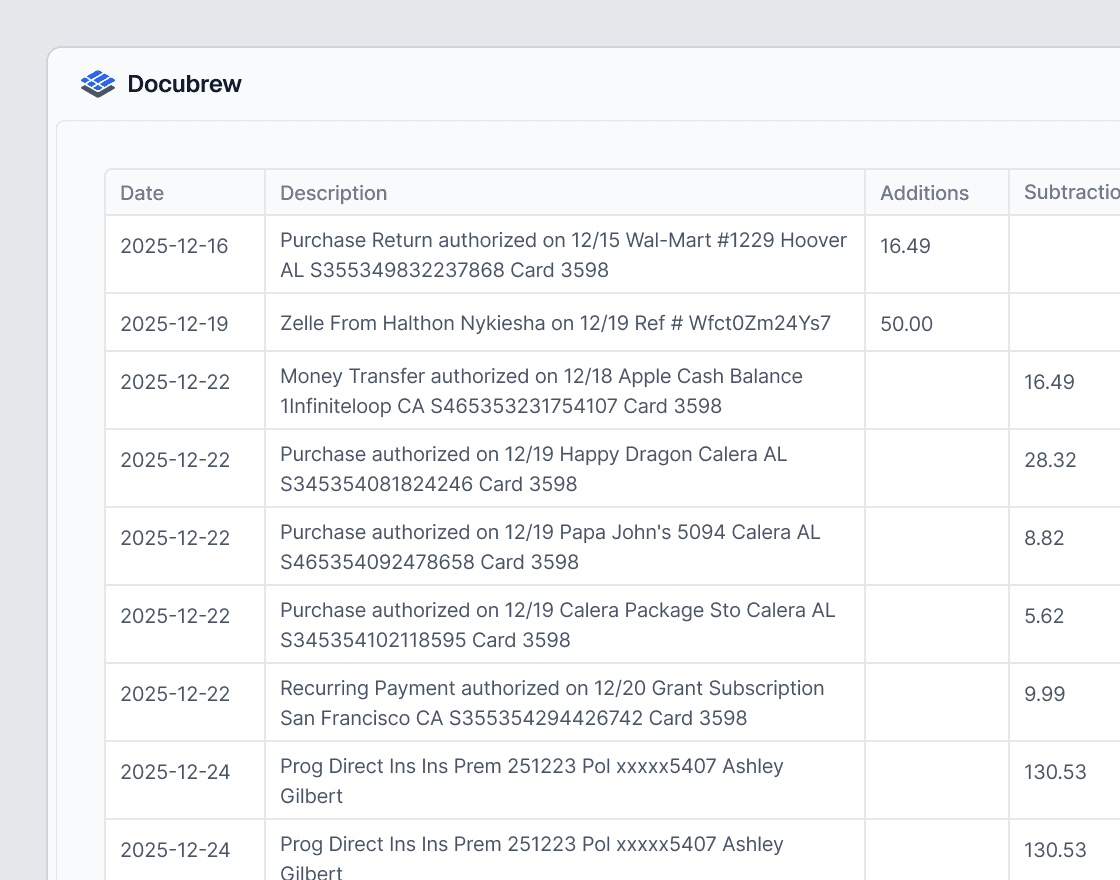
Image credit: docubrew.com
The number of pages doesn’t necessarily indicate more information.
Look at the company that is looking over its banking operations over a period of months. Although each PDF may have 10 or more pages, only a small portion of it contains the tables necessary for accounting.
A solution is to manually copy these tables, however this may be slow and may lead to typing mistakes. Businesses can instead convert bank statements to Excel while limiting the conversion to relevant pages.
Docubrew’s page preview lets a user to review the page and choose which pages to process. It is possible to remove disclosures, cover sheets, or other pages you don’t require.
You are more in control when you preview first
Automation is most effective in situations where the user is able to observe what’s happening.
Docubrew’s Preview feature allows users to preview the pages of the financial statement before they convert it. It extracts figures from the statement source instead of estimating the financial values.
The preview is an excellent method of ensuring that the pages you want to download are selected correctly and to review the information gathered prior to download the final results.
The checkpoint can be simple however it’s crucial when dealing with financial records.
The Export’s Form should be influenced by the Destination
What are your plans for the deal?
Excel is very useful when a bookkeeper wants to sort the data, look over rows, or alter the data. CSV could be a better choice if you are transferring the data to another system. Docubrew can support QBO output.
A person who has to convert a bank statements into CSV For instance, can generate CSV instead of creating a CSV rather than making an Excel workbook in the beginning and manually changing formats afterwards.
Docubrew’s output was designed to be used with accounting platforms such as QuickBooks, Xero, and FreshBooks in addition to spreadsheet-based workflows.
Scanned Paper Statements and Scanned Documents Can Be Part of the same Workflow
The use of selective conversion isn’t restricted to PDFs that are digitally created.
Certain companies only have old statements on paper. Docubrew has the ability to scan PDF documents, like statements.
This is useful in bookskeeping projects that have historical origins, in which the current records are digital but earlier documents were scanned from paper. Instead of having two different workflows, the files can be processed through the same process of conversion and reviewed before export.
Locally process or use the Cloud
It is essential to take into consideration how documents are handled, as well as their output.
Docubrew’s Windows Desktop application can convert documents locally on the client’s PC. Cloud processing is offered to users who prefer browser-based processes. Docubrew says that uploaded documents are secure and transferred documents and documents will be deleted automatically within 24 hours.
The final step of converting the bank statement as PDF to Excel is not to input each page into the software, hoping for a useful output.
Begin by looking through the pages containing the information that you need. Go over what’s being taken. Choose the format that is most suitable to the new accounting job.
It’s possible to create a more efficient financial workflow by deliberately processing less instead of processing more.